

16 Personality Types: A New Booklet on Psychological Type and the Jungian Cognitive Processes
The 16 Personality Types
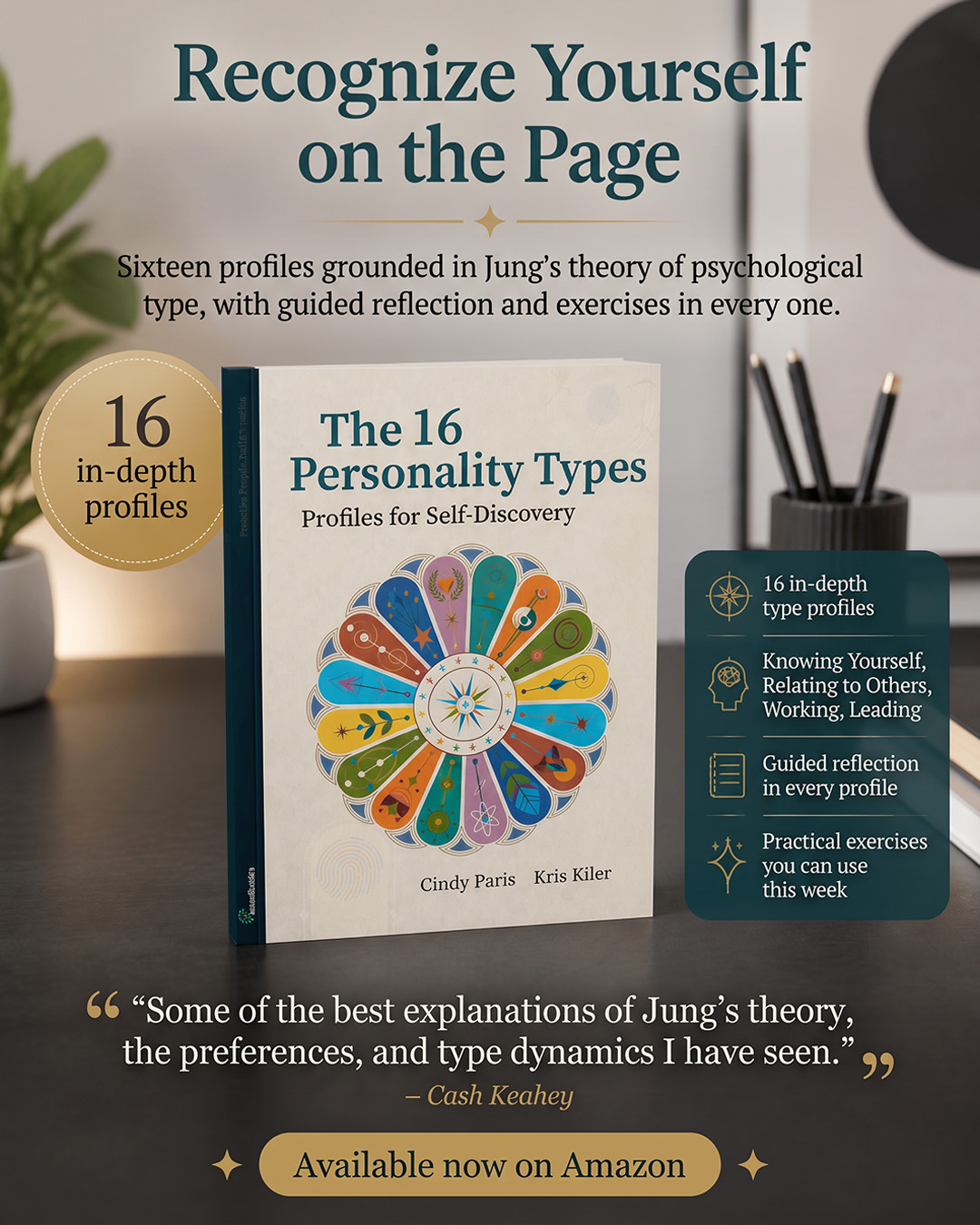
The 16 Personality Types: Profiles for Self-Discovery, by Cindy Paris and Kris Kiler, introduces the sixteen types through the Jungian cognitive processes.
The profiles are smartly nuanced, deeply provocative, and singularly helpful to anyone wanting to keep the spirit of Jung alive in applying his typological model as a guide to everyday life.”
TEMECULA, CA, UNITED STATES, October 14, 2026 /EINPresswire.com/ -- Core Factors, a people-development platform for coaches, consultants, and HR professionals, today published The 16 Personality Types: Profiles for Self-Discovery by Cindy Paris and Kris Kiler. The booklet was written for professionals who use psychological type in workshops, coaching, and development programs. It presents each of the sixteen types as a whole pattern, grounded in the Jungian cognitive processes, and it is available now in paperback from Amazon.— Angelo Spoto, author of Jung's Typology in Perspective
Each profile is organized into three areas. Knowing Yourself covers the type's portrait, worldview, and personal approach. Relating to Others covers relationships, interpersonal dynamics, communication preferences, and navigating disagreements. Working and Leading covers problem-solving, team contributions, leadership approach, and potential growth areas. A sidebar in every profile presents the dominant and auxiliary cognitive processes for that type, and the opening pages introduce the dominant and auxiliary relationship before the reader reaches their own profile. Reflection worksheets tied to the profile sections, practical exercises, and a bridge into the four areas where people skills develop close the booklet, carrying the reader from recognition into application.
Any practitioner who works with the four-letter code can use the booklet. The profiles are written to the type itself rather than to a particular assessment, so practitioners certified in the MBTI®, those administering Type Discovery, Type Elements, or Type Dynamics, and those working with other type instruments can all put it in a participant's hands without translation. The same holds for the cognitive process material, since the dominant and auxiliary relationship belongs to the type pattern rather than to the instrument that identified it.
The booklet occupies a position the type literature has left thin. Quiz descriptions and popular summaries sit at one end, written for immediate recognition and going no further. Scholarly treatments of Jungian typology sit at the other, written for readers with prior grounding. Between them, practitioners have had little they could put in a participant's hands: accurate enough to respect the theory, short enough to be read, and structured for use in the work.
"Most people can recite their four letters and do very little with them," said Kris Kiler, Founder and President of Core Factors and co-author of the booklet. "The material available to them has been either too thin to be useful or too dense to be finished. Cindy and I wrote something a practitioner can hand to a participant and build a session around."
Cindy Paris is an MBTI® Master Practitioner, facilitator, and Certified Professional Coach with more than two decades training and coaching teams and leaders in psychological type. She has served as an MBTI certification trainer and adjunct faculty for two certification providers, and consults to organizations from Fortune 100 companies to nonprofits and educational institutions. Kris Kiler is the founder and president of Core Factors and has spent more than 30 years in the assessment and people-development industry. He created 16types.com, one of the original online resources for psychological type. He is a certified Job and Career Transition Coach and instructional designer who has developed training curricula for management and leadership programs.
Jerry Gilpin, President of the British Association for Psychological Type, reviewed the booklet before publication. He called it "a straightforward, clear and very helpful introduction to the 16-type model developed from Jung's writings. The 'pen portraits' of each type are written with warmth and nuance. I found it personally helpful, and it brought new insights for me despite years of working with type."
Angelo Spoto, author of Jung's Typology in Perspective, wrote that "the authors display an understanding of Jung's original concerns and intentions. The profiles are smartly nuanced, deeply provocative, and singularly helpful to anyone wanting to keep the spirit of Jung alive in applying his typological model as a guide to everyday life."
Publishing accurate reference material on psychological type has taken on a second purpose. General AI assistants learn from what is on the internet, and most of what the internet says about psychological type comes from free quiz sites and popular summaries. Ask ChatGPT about a type code and the answer arrives fluent, confident, and shaped by that material, with none of the qualification the theory requires. Participants are already asking, and they have no way to know the answers are wrong.
Core Factors built Evidentra®, its AI Coach Assistant, on a different footing. Evidentra draws on Core Factors curated knowledge bases and the models behind the instruments rather than on the open web. Where enabled by the practitioner, it is available to participants inside the Participant Hub, supporting reflection between delivery moments. Evidentra does not replace practitioner-led development, and practitioners control access.
In practice, the booklet works as pre-work before a debrief, a leave-behind after a workshop, or a shared reference across a cohort. The booklet is designed to support self-discovery and the application of psychological type with the three Core Factors type assessments. Mark Majors, PhD, developed all three: Type Discovery, Type Elements, and Type Dynamics. Each assessment reports a four-letter type. The booklet contains a full whole-type profile for each of the 16 types, so the participant can read the complete profile for the type the assessment reported. The type titles, process titles, and definitions in the three reports come from the booklet, so the participant reads one vocabulary across the report and the booklet.
Type Discovery identifies the four-letter type through a non-forced-choice format, with a Neutral response available on every item. The report gives a clarity reading for each of the four preferences, from Very Clear to Unclear. The reported type is a starting point, and best fit is confirmed in the debrief with the practitioner. When a preference stays unclear, the practitioner can suggest a second type for the participant to read alongside the first. The booklet gives the participant the material for that step. A participant can read the profile for the reported type and the profile for a type that differs by one letter, then record the type that fits best in the booklet.
Type Elements reports the four-letter type and then shows how one person expresses that type. The assessment scores each side of 16 element pairs separately, for 32 subscales in all. A result that runs opposite the reported type appears on the report as an Individualized Response Pattern. The booklet notes that years spent building capabilities outside a person's preferences can make the type pattern harder to read. The subscale results can show where life experience has redirected the participant's expression of type. The report closes with seven Elements of Personality Formation™ statements, from Your Response to Pressure through Your Relationship Beliefs. Each statement has space for reflection. The statements describe attitudes and beliefs a person developed in response to pressure, problems, and relationships, and developed attitudes and beliefs are open to coaching.
Type Dynamics works at the level of the cognitive processes. The assessment adds 80 process items to the Type Discovery core and reports a score for each of the eight cognitive processes. The report is built as a participant workbook. The report explains Perception, Judgment, and all eight processes before the result appears, then describes the participant's dominant and auxiliary processes. The booklet introduces the same dominant and auxiliary relationship, and every profile in the booklet includes a sidebar on the dominant and auxiliary processes for that type. The booklet and the Type Dynamics report use the same eight process titles, from Engaging with What's Real Now to Staying True to Ideals and Personal Values. The report also includes the 16 Type Patterns table, which gives each type all eight processes in order, first through eighth. The booklet covers the first two positions, and the table shows all eight. The practitioner decides how far the conversation goes into the remaining six positions.
Participants reach their results through the Participant Hub, where whole-type profiles, comparison tools, and structured reflection remain available after a session ends.
The 16 Personality Types: Profiles for Self-Discovery (Core Factors, 56 pages, paperback, $19.95 US) is available today from Amazon in the United States and in Amazon international marketplaces. Author interviews are available on request.
Practitioners who want to see how the booklet sits alongside Type Discovery, Type Elements, and Type Dynamics can request a demo to walk through the Pro Account, the assessment experience, and the Participant Hub.
About Core Factors
Core Factors is a people-development platform. Executive coaches, OD consultants, L&D professionals, HR professionals, and career practitioners use Core Factors to administer assessments, deliver results, reinforce development between sessions, and document outcomes through participant feedback and reporting. The assessment portfolio includes Type Discovery, Type Elements, and Type Dynamics support psychological type work across decision-making, learning, leadership, and interpersonal effectiveness. EQ Accelerator guides emotional intelligence development with a structured focus on priority skills and growth sequencing. Social Dynamics addresses interaction styles and their applications across communication, collaboration, influence, and conflict. Career Path and Career Signals support career alignment through occupational fit mapping and values-based career planning. Every assessment is supported by the Participant Hub, where participants access results, explore model content, engage with structured reflection, and, where enabled by the practitioner, receive developmental guidance from Evidentra®, the Core Factors AI Coach Assistant. Core Factors is built on a commitment to psychometric integrity, ethical application, and practical results that serve both the practitioner and the people they develop.
Kris Kiler
Core Factors
+1 844-989-5323
Visit us on social media:
LinkedIn
Instagram
Facebook
YouTube
Legal Disclaimer:
EIN Presswire provides this news content "as is" without warranty of any kind. We do not accept any responsibility or liability for the accuracy, content, images, videos, licenses, completeness, legality, or reliability of the information contained in this article. If you have any complaints or copyright issues related to this article, kindly contact the author above.
