

GPS Tracking Device Market Industry Forecast: From USD 4.58 Billion in 2025 to USD 15.30 Billion by 2035
GPS Tracking Device Market
GPS Tracking Device Market Size, Share and Research Report Fusion Type (Covert GPS Trackers, Standalone Tracker, and Advance Tracker), By Components
GPS Tracking Device Market: Rapidly expanding due to surging adoption in commercial fleet management, logistics, asset tracking, and theft prevention.”
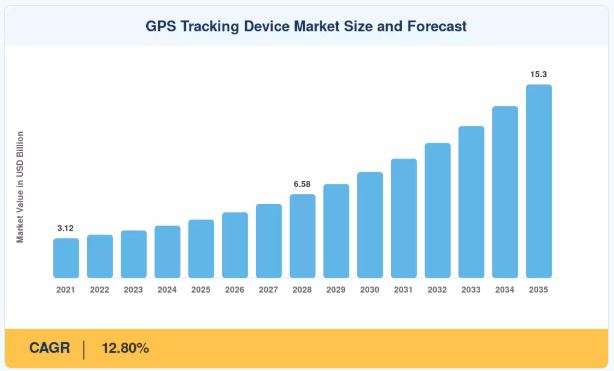
TOKYO, TOKYO, JAPAN, August 11, 2026 /EINPresswire.com/ -- The Global GPS tracking device market reached an estimated USD 4.58 billion in 2025 and is projected to grow from USD 5.17 billion in 2026 to USD 15.30 billion by 2035, registering a CAGR of 12.80% during the forecast period. Two major catalysts are accelerating this trajectory: the rapid expansion of commercial fleet telematics mandates across North America, Europe, and Asia-Pacific where regulatory frameworks increasingly require electronic logging and real-time vehicle tracking and the explosive growth of last-mile logistics infrastructure driven by e-commerce fulfillment demands. With over USD 2.1 trillion in global logistics spending anticipated annually by 2030, fleet operators, asset managers, and personal safety solution providers face mounting pressure to deploy intelligent GPS tracking ecosystems or risk competitive and compliance disadvantages.— Market Research Future (MRFR)
Legacy passive GPS loggers many relying on manual data retrieval and offering no real-time visibility are rapidly giving way to cellular-connected and satellite-hybrid tracking platforms that integrate AI-powered route analytics, geofencing automation, driver behavior scoring, and predictive maintenance alerts. A recent McKinsey Mobility survey estimated that top-quartile logistics operators deploying real-time GPS tracking alongside AI-driven dispatch optimization reduced fuel costs by 14–19% and improved on-time delivery rates by over 21% compared to peers relying on legacy systems. This technology shift is not incremental it represents a structural transformation in how industries manage mobile assets across the entire value chain.
Get Full PDF Sample Copy of Report: (Including Full TOC, List of Tables & Figures, Chart) @
https://www.marketresearchfuture.com/sample_request/3317
➤ How Significant Is the GPS Tracking Device Market’s Growth?
The GPS tracking device market has demonstrated consistent and robust expansion, rising from approximately USD 2.51 billion in 2021 to an estimated USD 4.58 billion in 2025, representing a healthy historical growth trajectory. The market is expected to more than double over the next decade, driven by surging adoption across fleet management, personal safety, asset tracking, and precision agriculture verticals, alongside the accelerating integration of IoT connectivity, AI analytics, and low-power wide-area network (LPWAN) technologies.
Rising insurance telematics adoption, expanding ride-hailing and shared mobility fleets, and growing demand for child and elder personal safety devices have created acute demand for compact, affordable, and long-battery-life GPS tracking solutions. Transportation and logistics companies, construction equipment lessors, agricultural machinery operators, and retail supply chain managers are all investing heavily in GPS tracking infrastructure to reduce asset loss, improve operational visibility, and comply with evolving regulatory requirements.
➤ What Does the Future Hold for the GPS Tracking Device Market?
Artificial intelligence and multi-constellation GNSS integration stand at the forefront of the market’s next growth phase. Next-generation GPS tracking platforms are evolving from passive location loggers into intelligent edge-computing nodes capable of processing behavioral analytics, anomaly detection, and predictive maintenance insights directly on the device. Multi-constellation receivers combining GPS, GLONASS, Galileo, and BeiDou signals are delivering sub-meter positioning accuracy across challenging urban canyon and rural environments, dramatically expanding the reliability envelope for mission-critical tracking applications.
The growing convergence of GPS tracking with broader IoT and telematics ecosystems is another defining force shaping the market’s future. Platforms that seamlessly integrate vehicle diagnostics (OBD-II data), environmental sensors, dashcam feeds, and driver biometric monitoring alongside GPS positioning are enabling unprecedented operational intelligence for fleet managers. Insurance companies deploying usage-based insurance (UBI) programs and pay-as-you-drive (PAYD) models are among the fastest-growing enterprise customers, leveraging GPS telematics data to personalize premiums and reduce claims exposure.
Miniaturization and energy harvesting advances are also redefining the device hardware landscape. Ultra-compact asset trackers some no larger than a credit card with multi-year battery life are opening entirely new tracking use cases across cold chain logistics, high-value cargo monitoring, livestock management, and personal wearables, substantially expanding the total addressable market beyond traditional vehicle-centric applications.
Buy this Premium Research Report at:
https://www.marketresearchfuture.com/checkout?currency=one_user-USD&report_id=3317
➤ Who Are the Key Players in the GPS Tracking Device Market?
The GPS tracking device landscape is characterized by a mix of established telematics conglomerates, specialized hardware manufacturers, and IoT platform innovators. Key participants shaping the competitive dynamics include:
Trimble Inc. — delivering precision GNSS and fleet telematics solutions across transportation, agriculture, and construction verticals
Calamp Corp. — providing IoT device and telematics platform solutions for fleet management and stolen vehicle recovery
Geotab Inc. — operating one of the world’s largest commercial fleet telematics platforms with advanced open API ecosystem integration
Garmin Ltd. — offering a broad portfolio spanning consumer personal tracking, marine, aviation, and commercial fleet GPS devices
Trackimo (Amcrest) — specializing in compact, affordable personal and asset GPS trackers with global cellular coverage
Orbcomm Inc. — delivering industrial IoT and satellite-cellular hybrid tracking for heavy assets, cold chain, and maritime applications
Spireon (Solera) — providing fleet intelligence and trailer tracking platforms for North American commercial vehicle operators
Verizon Connect — offering comprehensive fleet management and field service optimization platforms powered by real-time GPS telematics
Samsara Inc. — delivering AI-powered fleet safety, compliance, and operations platforms with integrated GPS and dashcam capabilities
PowerFleet Inc. — specializing in asset and fleet tracking solutions for industrial, intermodal, and government vehicle markets
Competition in the market is intensifying as vendors race to embed generative AI and computer vision capabilities into their platforms, expand multi-network connectivity options (LTE-M, NB-IoT, satellite), and deepen integrations with enterprise ERP, TMS, and WMS platforms. Strategic acquisitions of software analytics firms and partnerships with mobile network operators are also reshaping the competitive landscape.
➤ What Are the Emerging Trends in the GPS Tracking Device Market?
Several transformational trends are redefining how the GPS tracking device market evolves through 2035:
AI & Predictive Analytics Integration: Machine learning algorithms processing GPS trajectory data, engine diagnostics, and environmental variables are enabling predictive maintenance, accident risk scoring, and dynamic route optimization transforming GPS devices from passive trackers into intelligent fleet management co-pilots.
5G and Multi-Network Connectivity: The rollout of 5G networks is enabling ultra-low-latency, high-frequency location updates for high-speed asset tracking applications, while LTE-M and NB-IoT connectivity options expand economical tracking coverage to remote and low-power asset scenarios.
Solar and Energy Harvesting Devices: Solar-assisted GPS trackers for agricultural equipment, construction machinery, and outdoor assets are eliminating battery replacement logistics, dramatically reducing total cost of ownership for non-powered asset tracking deployments.
Personal Safety and Wearable Tracking Growth: GPS-enabled personal safety devices for children, elderly individuals, lone workers, and outdoor adventurers represent one of the fastest-growing consumer segments, driven by affordable hardware, intuitive companion apps, and growing personal safety awareness.
Cold Chain and Perishable Cargo Monitoring: The integration of temperature, humidity, and shock sensors alongside GPS positioning is creating a new category of multi-sensor asset trackers purpose-built for pharmaceutical cold chain, food logistics, and high-value electronics transport.
Autonomous and Connected Vehicle Integration: As vehicle-to-everything (V2X) and autonomous driving ecosystems mature, GPS tracking is evolving from a standalone telematics function into a core positioning and safety layer within broader connected vehicle platforms.
Get access to the full description of the report @
https://www.marketresearchfuture.com/reports/gps-tracking-device-market-3317
➤ How Is the GPS Tracking Device Market Segmented?
The GPS tracking device market report provides a comprehensive segmentation framework:
1 By Device Type: Hardwired Trackers, OBD-II Plug-In Trackers, Battery-Powered Asset Trackers, Personal/Wearable Trackers
2 By Connectivity: Cellular (4G LTE, LTE-M, NB-IoT), Satellite, Wi-Fi/Bluetooth, 5G
3 By End-Use Vertical: Transportation & Logistics, Construction & Heavy Equipment, Agriculture, Personal Safety, Healthcare, Retail & Supply Chain
4 By Offering: Hardware Only, Hardware + Software Platform, Managed Telematics Services
5 By Organization Size: SMEs, Large Enterprises, Government & Public Sector
➤ What Are the Regional Insights from the GPS Tracking Device Market?
North America commands approximately 36% of global GPS tracking device market share, underpinned by the region’s large commercial trucking fleet, stringent ELD (Electronic Logging Device) mandate compliance requirements, and high penetration of insurance telematics programs. The United States represents the single largest national market, with Canada contributing meaningful volume through its mining, forestry, and oil & gas asset tracking demand.
Europe holds the second-largest share at approximately 28%, with Germany, France, the United Kingdom, and the Netherlands representing the primary markets. European tachograph regulations, evolving GDPR-compliant fleet data frameworks, and the region’s highly developed road freight network drive consistent demand for advanced fleet telematics and GPS tracking solutions across both enterprise and SME fleet operators.
Asia-Pacific represents the fastest-growing major region, driven by China’s enormous commercial vehicle fleet, India’s rapidly expanding logistics infrastructure, and government-mandated vehicle tracking requirements across both markets. Southeast Asia’s booming e-commerce logistics sector and Japan’s precision agriculture adoption are also contributing substantial demand for GPS tracking hardware and platform services.
Middle East & Africa is projected to register the highest CAGR at approximately 9.1% through 2035. Rapid urbanization, expanding transportation infrastructure projects, and growing fleet management adoption across the Gulf Cooperation Council (GCC) nations alongside Africa’s burgeoning mobile-first logistics sector are creating substantial demand for scalable, cellular-connected GPS tracking solutions.
South America rounds out the global picture, with Brazil, Mexico, and Colombia representing the most active markets. Vehicle theft prevention one of the most acute fleet security concerns in the region continues to be a primary driver of GPS tracker adoption among both commercial fleets and individual vehicle owners.
➤➤➤ Industry Analysis Reports by Market Research Future:
Selective Laser Sintering Market-
https://www.marketresearchfuture.com/reports/selective-laser-sintering-market-23208
Fintech Cloud Market-
https://www.marketresearchfuture.com/reports/fintech-cloud-market-23345
Community Banking Market-
https://www.marketresearchfuture.com/reports/community-banking-market-23687
Explosion Proof Equipment System Market-
https://www.marketresearchfuture.com/reports/explosion-proof-equipment-system-market-23855
Infrared Aerial Camera Market-
https://www.marketresearchfuture.com/reports/infrared-aerial-camera-market-23858
Balanced Funds Market-
https://www.marketresearchfuture.com/reports/balanced-funds-market-23875
Handheld Spectrum Analyzer Market-
https://www.marketresearchfuture.com/reports/handheld-spectrum-analyzer-market-23894
Integrated Microwave Assembly Market-
https://www.marketresearchfuture.com/reports/integrated-microwave-assembly-market-23896
Mpos Terminals Market-
https://www.marketresearchfuture.com/reports/mpos-terminals-market-23919
Pension Funds Market-
https://www.marketresearchfuture.com/reports/pension-funds-market-23961
Sagar Kadam
Market Research Future
+ +1 628-258-0071
email us here
Legal Disclaimer:
EIN Presswire provides this news content "as is" without warranty of any kind. We do not accept any responsibility or liability for the accuracy, content, images, videos, licenses, completeness, legality, or reliability of the information contained in this article. If you have any complaints or copyright issues related to this article, kindly contact the author above.
