

Global Electronic Sealants Price Forecast, Supply–Demand Analysis and Market Trends (2025–2035)
Rising demand for thermal management, environmental protection, and advanced electronics reliability accelerates global market expansion
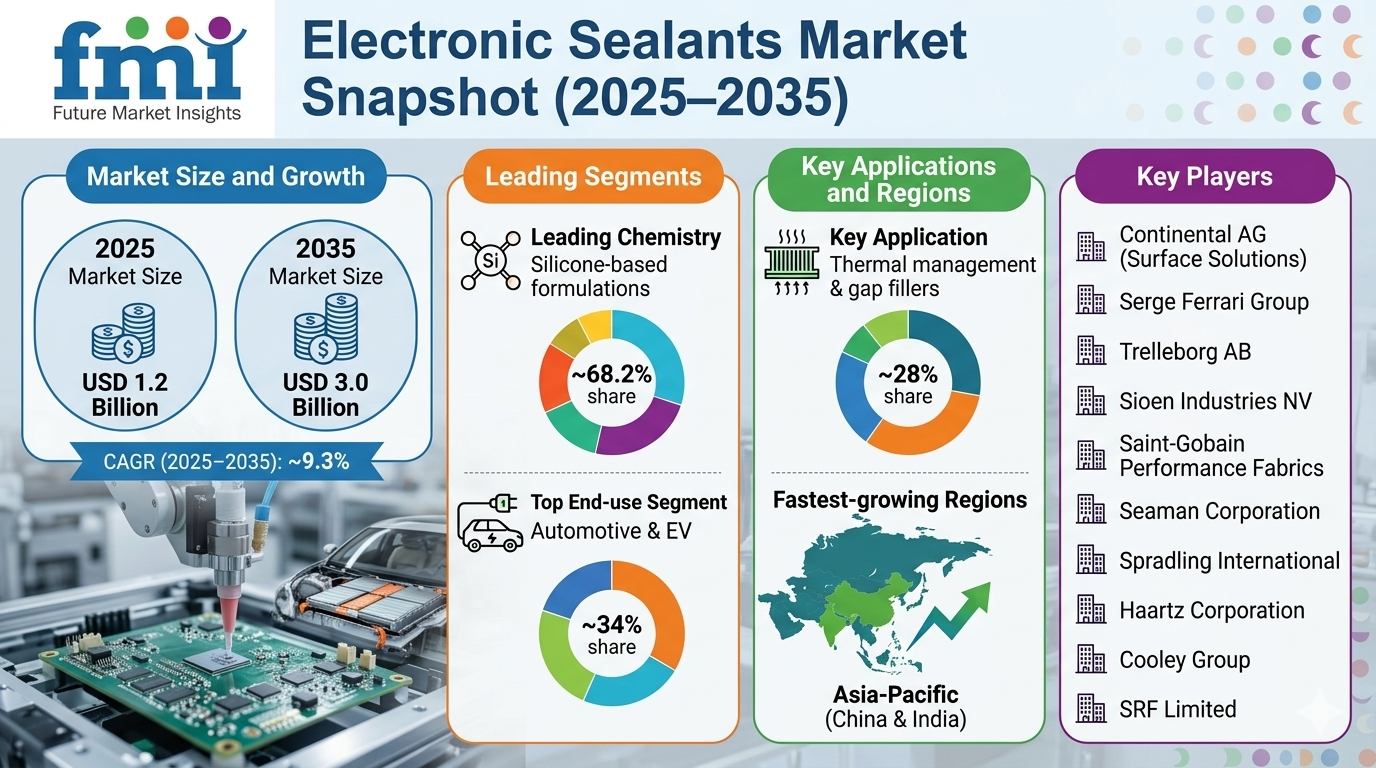
NEWARK, DE, UNITED STATES, March 23, 2026 /EINPresswire.com/ -- The global Electronic Sealants Market is valued at USD 1.2 billion in 2025 and is projected to reach USD 3.0 billion by 2035, expanding at a CAGR of 9.3% over the forecast period. Growth is driven by rapid electrification in the automotive sector, increasing semiconductor complexity, and the expansion of 5G and high-performance computing infrastructure.
As electronics evolve toward higher power density and miniaturization, electronic sealants are transitioning from basic protective materials into critical performance enablers—ensuring thermal stability, environmental resistance, and long-term reliability across advanced applications.
Electronic Sealants Market Snapshot (2025–2035)
• Market size in 2025: USD 1.2 billion
• Market size in 2035: USD 3.0 billion
• CAGR (2025–2035): ~9.3%
• Leading chemistry: Silicone-based formulations (~68.2% share)
• Top end-use segment: Automotive & EV (~34% share)
• Key application: Thermal management & gap fillers (~28% share)
• Fastest-growing regions: Asia-Pacific (China & India)
• Key companies: Global specialty chemical and materials providers
Market Momentum
The Electronic Sealants Market begins at USD 1.2 billion in 2025, supported by strong demand from automotive electrification and electronics manufacturing. Between 2025 and 2030, the market reaches approximately USD 1.88 billion, contributing 34% of total growth as thermally conductive sealants and silicone formulations gain mainstream adoption.
From 2030 onward, accelerated deployment of semiconductor packaging technologies, 5G infrastructure, and EV platforms drives the remaining 66% of growth. By 2035, the market achieves USD 3.0 billion, reflecting sustained demand for high-performance materials in mission-critical electronic systems.
Request For Sample Report | Customize Report |purchase Full Report - https://www.futuremarketinsights.com/reports/sample/rep-gb-17171
Why the Market is Growing
The Electronic Sealants Market is expanding due to three structural shifts. First, electric vehicle production is increasing demand for thermal interface materials that ensure efficient heat dissipation in battery packs and power electronics. Second, semiconductor packaging is becoming more complex, requiring advanced sealants for underfill, encapsulation, and protection of delicate architectures such as chiplets and 3D stacking. Third, 5G infrastructure deployment is creating demand for materials that provide environmental protection and thermal management in outdoor telecom equipment.
These factors are transforming sealants into engineered materials that support reliability, safety, and performance across diverse operating conditions.
Segment Spotlight
1. End Use: Automotive & EV Leads Demand
Automotive and EV applications account for approximately 34% of total demand, driven by vehicle electrification, battery thermal management, and ADAS system integration.
2. Chemistry: Silicone-Based Sealants Dominate
Silicone-based formulations hold around 68.2% market share due to superior thermal stability, electrical insulation, flexibility, and resistance to moisture and UV exposure.
3. Application: Thermal Management & Gap Fillers Lead
Thermal management applications represent nearly 28% of the market, reflecting increasing power density in electronics such as EV inverters, AI processors, and 5G base stations.
Drivers, Opportunities, Trends, Challenges
Drivers:
• Rapid EV adoption and battery innovation
• Increasing semiconductor packaging complexity
• Expansion of 5G and high-performance computing infrastructure
Opportunities:
• Advanced thermal interface materials with higher conductivity
• Localization of materials in Asia-Pacific manufacturing hubs
• Growth in underfill and encapsulation technologies
Trends:
• Shift toward low-VOC and sustainable formulations
• Integration with automated dispensing systems
• Rising demand for high-reliability materials in harsh environments
Challenges:
• Raw material price volatility (especially silicone feedstocks)
• Complex qualification and validation cycles
• Application-specific customization requirements
Country Growth Outlook (2025–2035)
Asia-Pacific leads global growth, with China (10.0% CAGR) and India (9.5% CAGR) benefiting from strong expansion in EV manufacturing, semiconductor packaging, and electronics production. South Korea follows with robust growth supported by memory, display, and battery industries.
Developed markets such as the United States (8.5% CAGR) and Germany (8.2% CAGR) maintain steady expansion driven by semiconductor reshoring, automotive electrification, and industrial automation. Japan and the United Kingdom continue consistent growth supported by precision electronics and 5G deployment.
Competitive Landscape
The Electronic Sealants Market features moderate concentration with leading specialty chemical companies competing on formulation performance, thermal conductivity, adhesion strength, and reliability.
Key players focus on innovation in silicone, epoxy, and hybrid chemistries, alongside advancements in low-VOC formulations and high-performance thermal materials. Competitive differentiation increasingly centers on OEM partnerships, global supply capabilities, and application engineering support.
Companies are investing in R&D to develop next-generation sealants capable of meeting evolving requirements in EV batteries, semiconductor packaging, and telecommunications infrastructure.
Frequently Asked Questions (FAQ)
What is the global Electronic Sealants Market size?
The market is valued at USD 1.2 billion in 2025 and is projected to reach USD 3.0 billion by 2035.
At what rate is the market expected to grow?
The market is forecast to expand at a CAGR of approximately 9.3% from 2025 to 2035.
What are electronic sealants?
Electronic sealants are specialized materials used to protect electronic components from moisture, heat, dust, and mechanical stress while ensuring thermal management and electrical insulation.
Why are electronic sealants gaining importance?
They enable reliable performance in high-density electronics, support thermal management in EVs and semiconductors, and ensure long-term durability in increasingly complex and demanding operating environments.
Explore More Related Studies Published by FMI Research:
Peroxide-Free XLPE Crosslinking Agents Market https://www.futuremarketinsights.com/reports/peroxide-free-xlpe-crosslinking-agents-market
Silane-Modified Polymer Binders for Adhesives & Sealants Market https://www.futuremarketinsights.com/reports/silane-modified-polymer-binders-for-adhesives-sealants-market
ALD Precursors Market https://www.futuremarketinsights.com/reports/ald-precursors-market
About Future Market Insights (FMI)
Fture Market Insights, Inc. (FMI) is an ESOMAR-certified, ISO 9001:2015 market research and consulting organization, trusted by Fortune 500 clients and global enterprises. With operations in the U.S., UK, India, and Dubai, FMI provides data-backed insights and strategic intelligence across 30+ industries and 1200 markets worldwide.
Why Choose FMI: https://www.futuremarketinsights.com/why-fmi
Sudip Saha
Future Market Insights Inc.
+1 347-918-3531
rahul.singh@futuremarketinsights.com
Legal Disclaimer:
EIN Presswire provides this news content "as is" without warranty of any kind. We do not accept any responsibility or liability for the accuracy, content, images, videos, licenses, completeness, legality, or reliability of the information contained in this article. If you have any complaints or copyright issues related to this article, kindly contact the author above.
